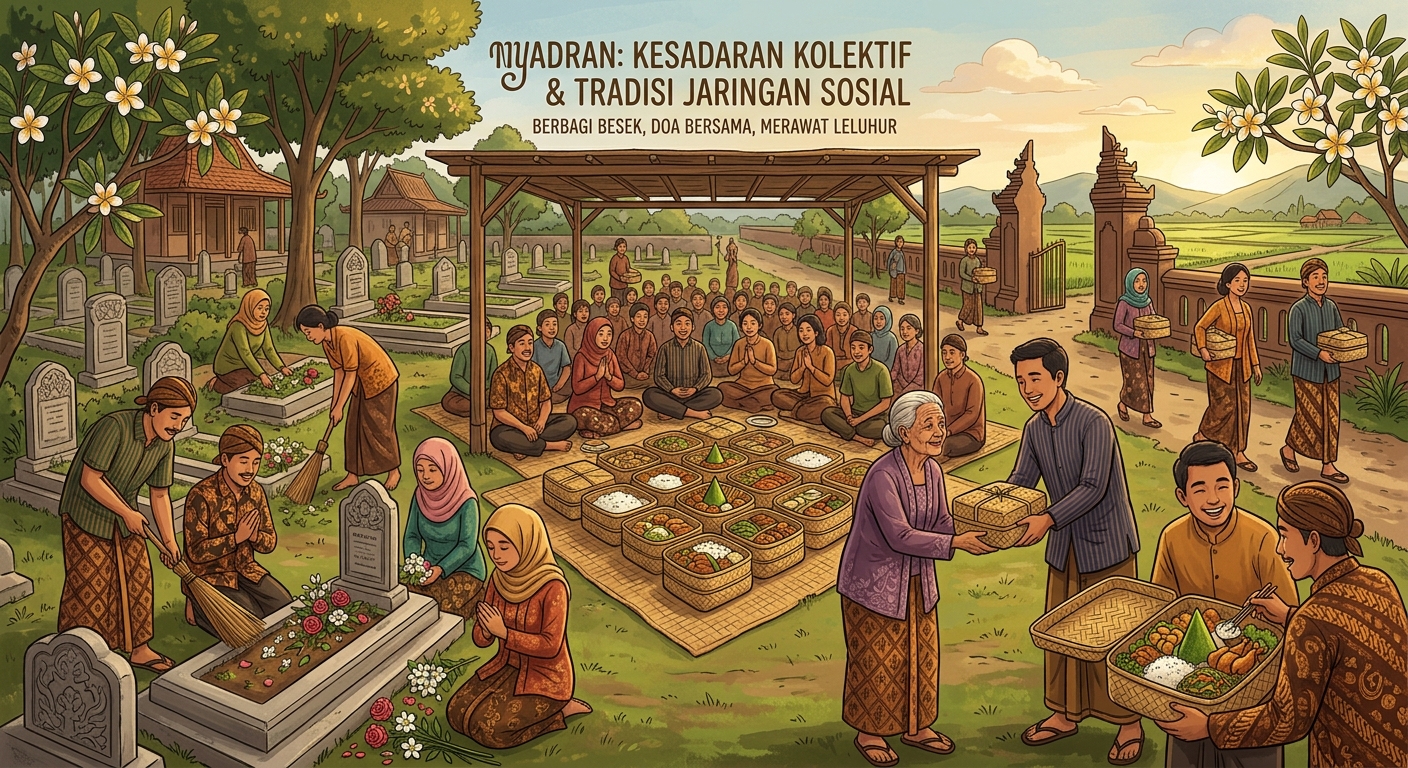
Getting to Know Nyadran and Its Connection to Collective Awareness
Nyadran, a tradition we have long understood as cultural heritage, may also offer us a point of reference for imagining how collective responses to climate change can be built.
When climate change is discussed today, the conversation often begins with large things: international agreements, renewable energy, carbon markets, technological innovation, or government policy. These are undoubtedly important. Yet climate change is also a problem of how people understand their relationship with one another. It raises a deceptively simple question: when a problem affects everyone, how do we learn to act collectively?
Perhaps some answers can be found in places we rarely consider political or environmental at all.
One of them is Nyadran.
Nyadran is a communal tradition practiced in many Javanese communities, particularly in Central Java and Yogyakarta. Commonly held during the Javanese month of Ruwah, before Ramadan, the tradition usually involves cleaning ancestral graves, praying together, and sharing food through a communal feast or kenduri. Historically and culturally, Nyadran is often described as a form of religious and cultural heritage, shaped through the long encounter between Javanese traditions and Islam.
But to understand Nyadran only as heritage may overlook something important. Behind its prayers, food, baskets, and gatherings lies a particular way of organizing collective life.
During Nyadran in Grojogan Hamlet, Yogyakarta, for example, residents arrive carrying besek, woven bamboo baskets containing rice and several side dishes. The baskets are collected before the communal prayer begins. Yet something interesting happens afterward. A portion of food from each contribution is taken and recombined into additional baskets. Those additional baskets allow people who arrive without bringing food to still return home carrying a besek.
The arrangement is simple. Nobody delivers a speech about redistribution. Nobody publicly identifies who contributed more, who contributed less, or who came without anything. When the event ends, people simply receive baskets and go home.
This seemingly ordinary practice contains an important lesson about collective awareness.
Collective life does not always have to begin with an agreement expressed in words. Sometimes it is produced through repeated practices that gradually teach people what is considered proper, fair, and necessary. In Nyadran, people learn that bringing something into the community does not necessarily mean receiving exactly the same thing back. Food changes hands. Contributions lose their individual ownership. What begins as “mine” temporarily becomes “ours.”
The same principle can be seen in voluntary donations collected during the event. Contributions are placed anonymously, without public recognition of who gives what. The money is generally used for common purposes, such as maintaining ancestral graves and shared facilities.
There is no need to romanticize this practice. Nyadran does not eliminate inequality, solve poverty, or automatically produce an environmentally sustainable community. Nor should a centuries-old tradition be artificially transformed into a climate policy simply because contemporary society is searching for environmental solutions.
Its relevance lies somewhere else.
Climate change is fundamentally a collective-action problem. Individual choices matter, but their effects remain limited when institutions, markets, communities, and governments continue operating according to systems that reward unlimited consumption and individualized responsibility. Asking people simply to use fewer plastic bags, switch off lights, or buy environmentally friendly products can only go so far. Environmental problems require people to recognize that resources, risks, and responsibilities are interconnected.
Nyadran provides a small illustration of what such an understanding might look like in practice.
Within the ritual, sufficiency matters more than accumulation. Contributions circulate rather than remain attached to individual ownership. The person who has more is able to contribute without being celebrated as a benefactor, while the person who has less can receive without being publicly labelled as a beneficiary. Redistribution becomes part of the normal functioning of the community rather than an exceptional act of charity.
This is precisely where Nyadran can enter contemporary conversations about climate change.
The ecological crisis will require more than green technology. It will also require societies capable of accepting limits, sharing burdens, redistributing resources, and thinking beyond immediate individual interests. These capacities cannot simply be legislated into existence. They have to be socially cultivated.
Local traditions such as Nyadran therefore deserve to be approached not only as objects that need to be preserved, photographed, celebrated, or promoted as cultural tourism. They can also be read as repositories of social knowledge.
The challenge is not to return to the past. Nor is it to claim that traditional communities somehow possessed perfect ecological wisdom. The more productive question is what kinds of social principles embedded within these practices remain useful for thinking about contemporary problems.
Nyadran offers one possible answer: collective awareness may emerge when people repeatedly experience that living together involves more than protecting individual interests. It also involves knowing when to contribute, when to share, when to restrain oneself, and how to ensure that others remain part of the collective.
Perhaps climate action begins there too.
Not simply with knowing that the planet is warming, but with recovering the ability to understand that what we possess, consume, protect, and leave behind has always been connected to somebody else