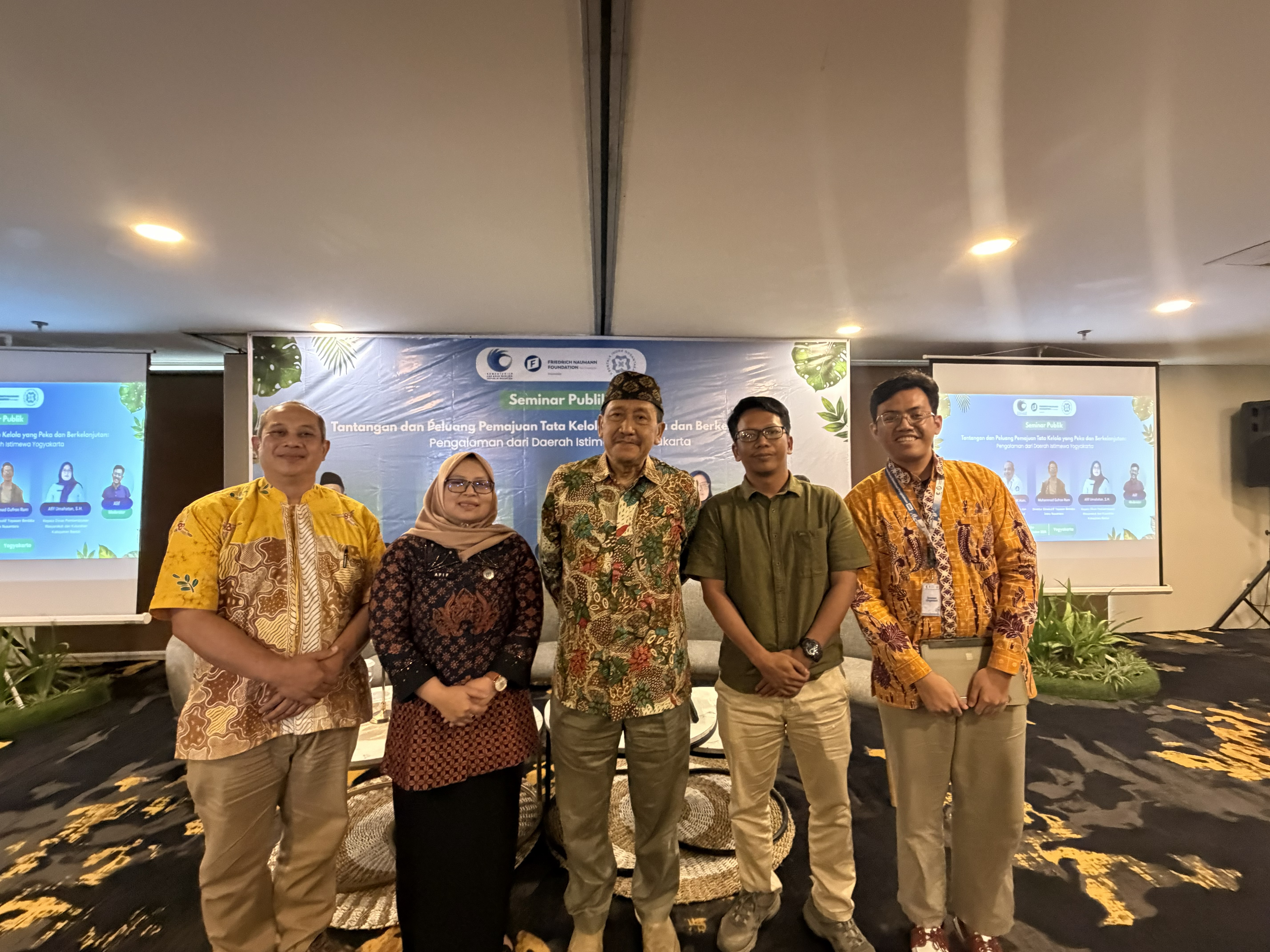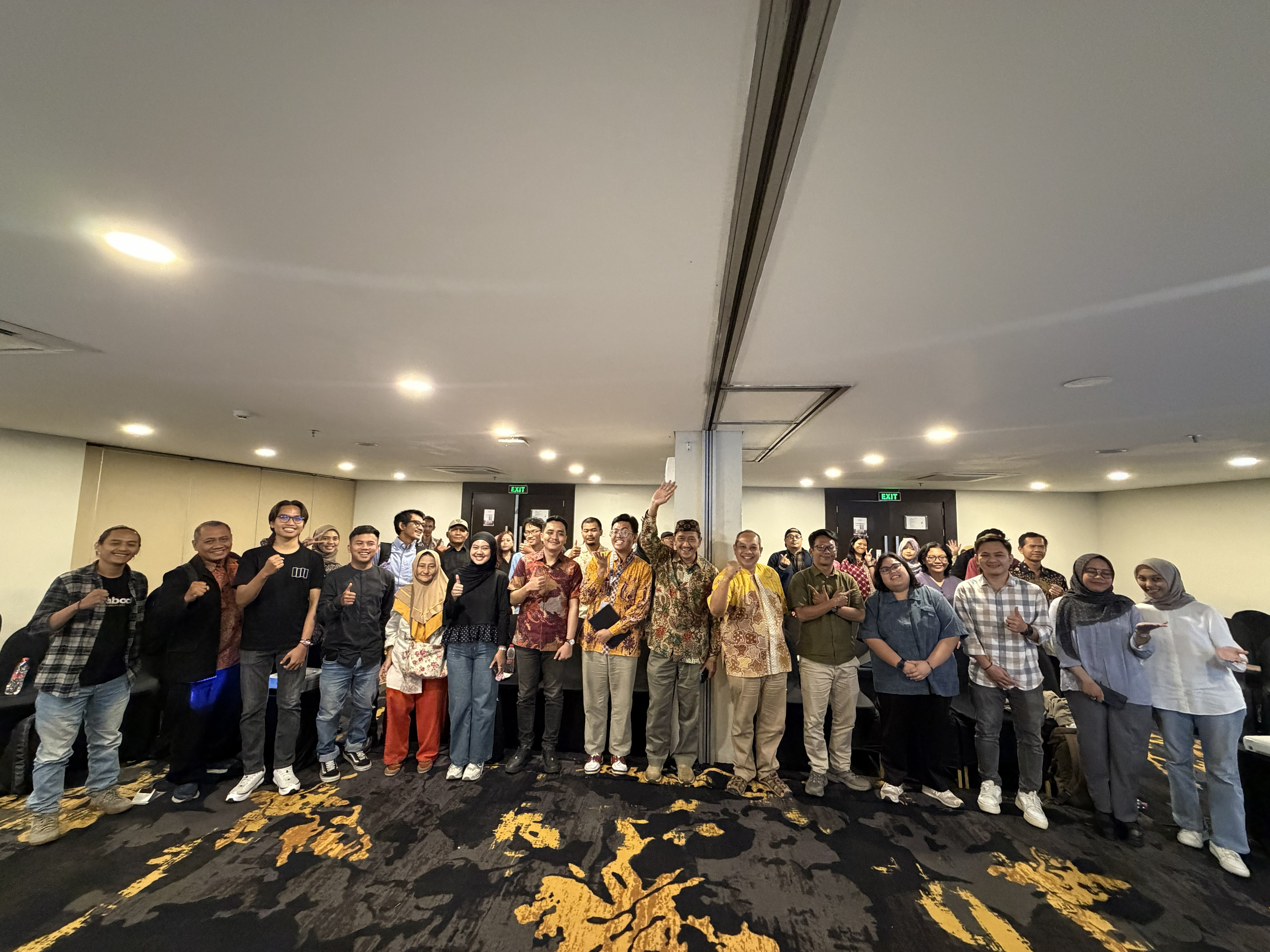
Supported by FNF Indonesia and Indonesia’s Ministry of Human Rights, BINA’s public seminar explored ways to advocate for citizens’ experiences and local values to inform policy formulation and implementation.
In rural communities, knowledge rooted in citizens' everyday experiences forms the foundation for collective decision-making. This enables the community to comprehend issues, define priorities, and foster collaborative action. Unfortunately, the dynamics of this local knowledge are frequently overlooked by the government when designing policies, especially regarding agricultural governance.
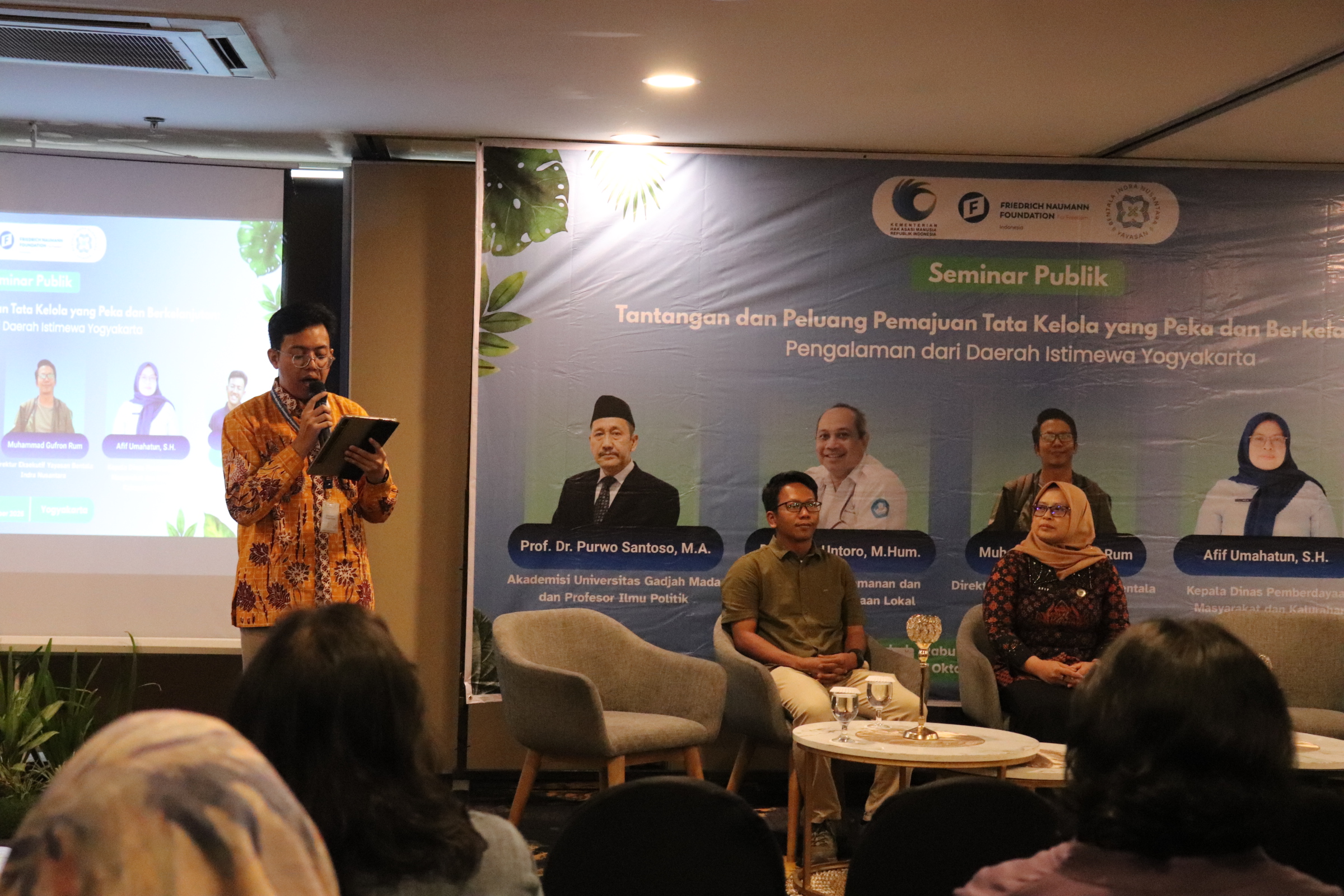
The relationship between local knowledge and public policy was the focal point of discussion in the Public Seminar titled “Challenges and Opportunities in Advancing Responsive and Sustainable Governance: Lessons from the Special Region of Yogyakarta.” The event was organized by the Bentala Indra Nusantara Foundation (BINA) in collaboration with the Friedrich Naumann Foundation for Freedom (FNF) Indonesia and the Ministry of Human Rights of the Republic of Indonesia on October 7, 2026, at the Horison Emerald Hotel Timoho, Yogyakarta.
Attended by 73 participants, the forum brought together representatives from government, academia, civil society organizations, and local citizens to deliberate on the position of local knowledge in governance. Through two panel discussions moderated by Muhammad Alif Dzulfikar, participants examined how community experiences can influence policy and how local values are applied in governance practices.
Listening to Citizens’ Experiences in Policymaking
Executive Director of BINA, Muhammad Gufron Rum, presented key insights gained from BINA’s initiatives in exploring local knowledge. According to him, policies must be formulated with a sufficiently detailed understanding of citizens' lives, including the experiences of marginalized groups whose voices are rarely heard.
Gufron utilized the coastline paradox analogy to illustrate this issue. The more detailed the scale of measurement, the more indentations become visible. In public policy, paying attention to the intricate details of citizens' daily lives enables decision-makers to identify needs and impacts that might otherwise be overlooked in program design.
BINA’s experience in accompanying agricultural communities served as a primary case study. In waste management initiatives in Bantul, for instance, the behavioral changes expected by policies must account for the daily routines of residents who balance work and family responsibilities. Adequate support services significantly determine whether community efforts can be sustained over the long term.
Gufron also shared an account of residents in a local village who independently constructed a joglo (a traditional Javanese structure) over three to four years. This experience demonstrated the community’s capacity to organize collective action and establish their own metrics of success based on their own capacities and collective needs.
These field insights and discussions laid the groundwork for BINA’s module on the critical integration of local knowledge. The module positions citizen engagement and sense of ownership as key indicators of policy success. Citizens must be afforded the space to actively shape policies and evaluate their benefits based on their own lived experiences.
Strengthening Participation in Village Governance
Head of the Bantul Regency Department of Community and Kalurahan Empowerment, Afif Umahatun, outlined opportunities for citizen engagement through village (kalurahan) development planning. Sub-village assemblies (musyawarah padukuhan) serve as an initial platform to deliberate proposals before they are integrated into development plans.
Afif explained that the Kalurahan Reform links bureaucratic enhancement with community empowerment. In Bantul, this effort is aligned with the development of culture-based kalurahan, incorporating practices of consensus-building (musyawarah) and social etiquette in community life. Furthermore, development planning is increasingly directed toward climate change responses and tailoring programs to regional potential.
However, implementation continues to face several challenges. Certain development proposals reflect desires rather than data-driven needs. Furthermore, physical attendance at assemblies does not always translate into active participation, as individuals holding influential positions tend to dominate discussions and budget allocations.
These conditions highlight the necessity of evaluating the quality of participation based on citizens' actual influence on decisions. Deliberative forums prove more effective when participants possess adequate information, feel empowered to articulate issues, and are given meaningful opportunities to discuss potential solutions.
During the dialogue session, Agus, a resident of Banguntapan, raised concerns regarding overflowing drainage channels and the limited access citizens have to public consultations. Responding to the query, Afif acknowledged the constraints in conducting public consultations while outlining various channels for submitting proposals through kalurahan and regency government levels as viable solutions.
This exchange underscored the critical connection between the availability of participatory mechanisms and the citizens' capability to utilize them. Information regarding channels for public grievance must be accessible, while citizens' lived experiences require clear and responsive consideration in decision-making processes.
Connecting Local Values with Development Practice
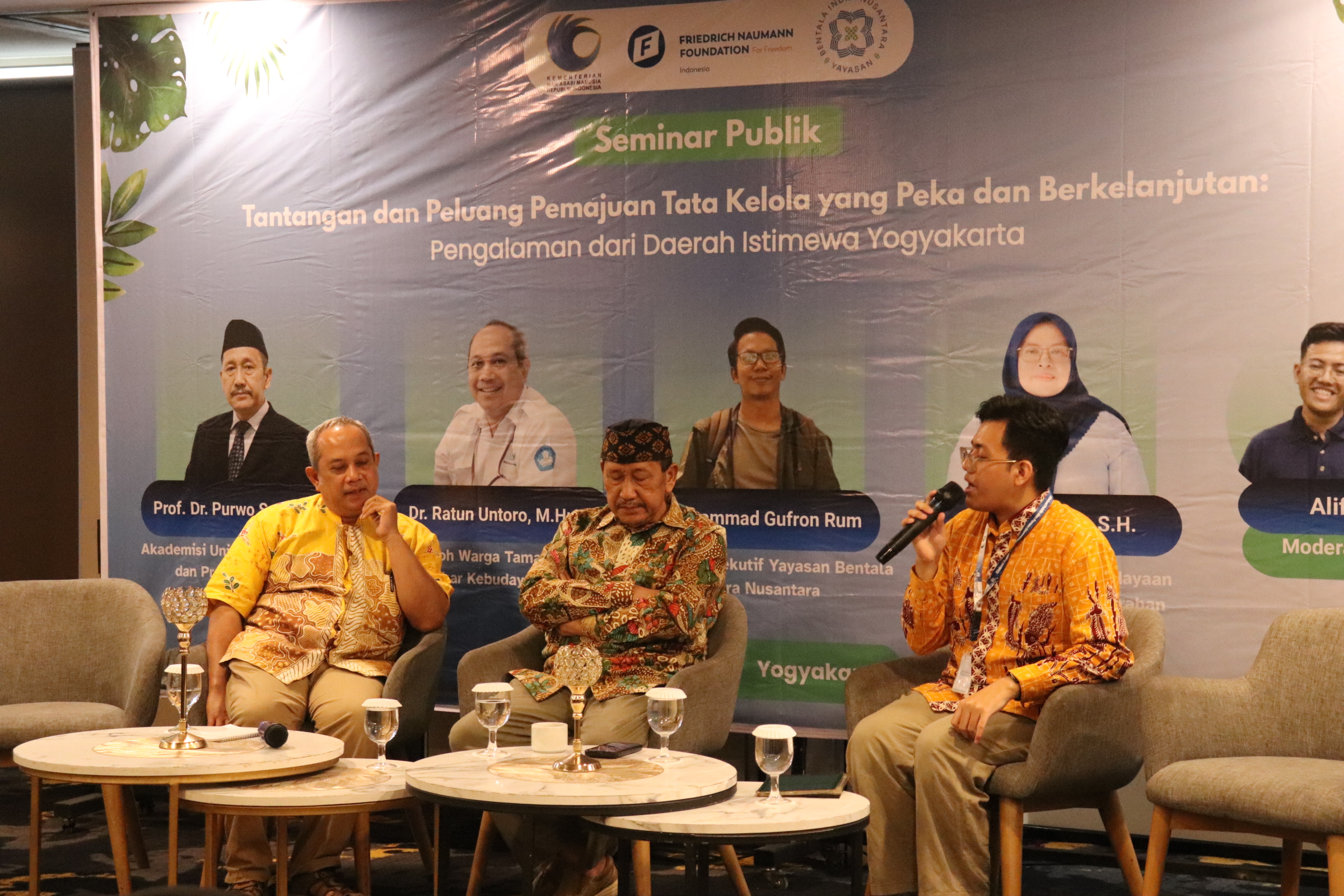
In the second panel, Dr. Ratun Untoro discussed local character as an integral part of development’s non-physical infrastructure. He argued that development initiatives must pay close attention to how communities understand collective living, practice active listening, and respond to systemic changes.
Ratun used the Javanese script (Aksara Jawa) as a reflective illustration. He noted that the absence of spaces between words in traditional Javanese writing serves as a symbolic reminder to listen holistically before responding. Through this interpretation, Ratun invited participants to recognize the vital connection between cultural heritage and the attitudes required in effective governance.
The discussion on local values was further expanded by Prof. Purwo Santoso, who highlighted the disconnect between the inclusion of the Hamemayu Hayuning Bawana philosophy in policy documents and its practical application in development planning. He emphasized that such philosophical values require actionable operationalization to meaningfully shape how governments comprehend problems and determine actions.
Prof. Purwo also cautioned academia to recognize the limitations of formal technical knowledge. He cited an example of a water retention basin in a karst area that unexpectedly dried up after sediment was cleared and its base was concrete-paved. In this instance, he implied that local residents had long understood the function of natural sediment in sealing rock pores to retain water long before technical expertise intervened.
This experience reinforces the imperative of bridging technical expertise with local community knowledge prior to implementing interventions. Knowledge arising from daily experiences can provide essential contextual understanding of local conditions that standardized technical approaches often fail to capture.
Making Local Knowledge a Basis for Shared Learning
As a way forward, Prof. Purwo proposed the curation of indigenous teachings—an effort to critically analyze living wisdom and translate its utility to address contemporary challenges. Cultural symbols can significantly enhance public communication when accompanied by a deep understanding of the underlying values and practices they embody.
One of the key ideas presented was the development of a living laboratory within a designated regional cluster. Through this concept, learning occurs organically by observing shared challenges alongside the community and assessing the real-world consequences of implemented actions. Consequently, local knowledge can be continuously examined and evolved in response to changing needs.
This seminar formed part of BINA’s broader initiative to explore and disseminate local knowledge, conducted in cooperation with FNF Indonesia in political education. The convergence of citizen experiences, government perspectives, and academic reflections creates a vital space to re-evaluate how public policies are formulated and executed.
The deliberations throughout the forum established a willingness to listen as the cornerstone of responsive governance. This willingness must be institutionalized through participatory spaces that empower local knowledge to inform decisions, while simultaneously assisting the government in measuring the tangible benefits of policies in everyday life
.